ASUS vs. HP: Which Laptop Brand Should You Buy in 2026?
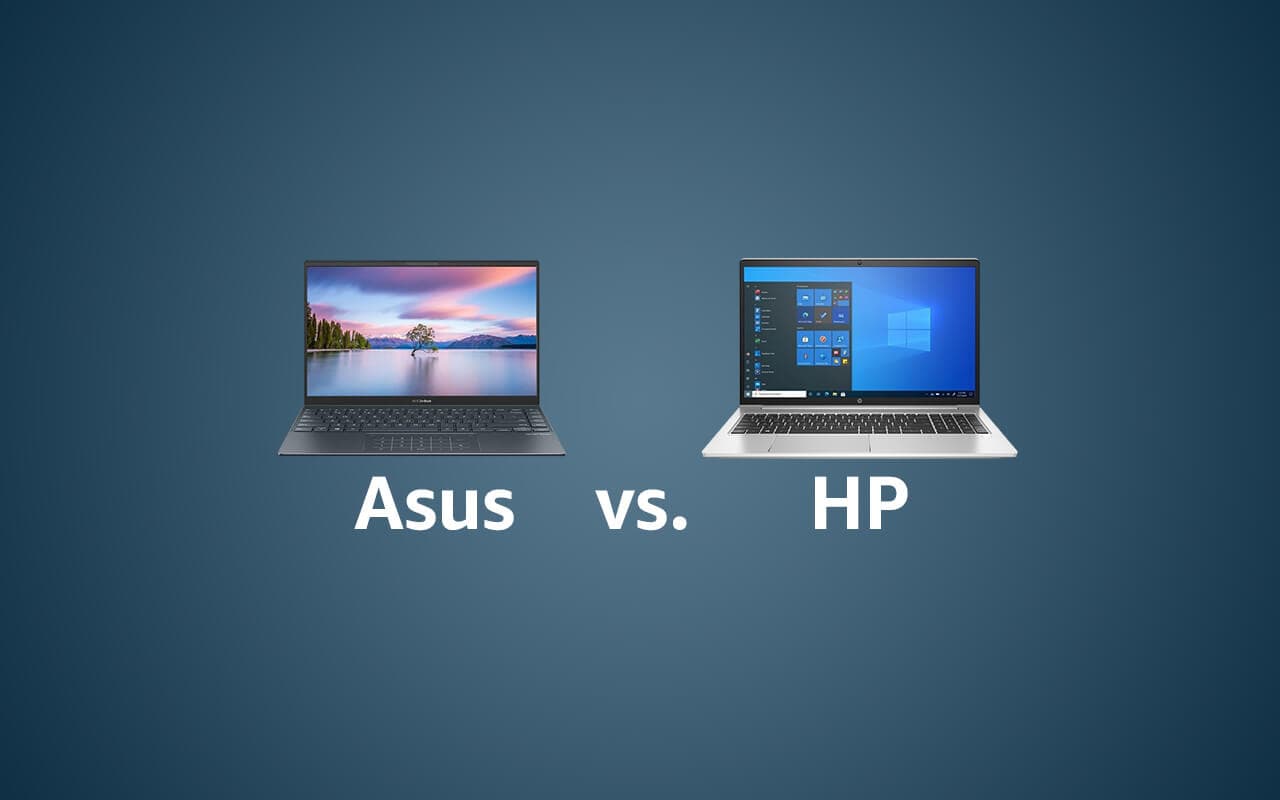
Disclosure: This post may contain affiliate links. If you purchase through these links, we may earn a small commission at no extra cost to you.
ASUS and HP are two of the biggest names in laptops, and if you're cross-shopping them, the honest answer is that neither brand is simply "better." They're strong in different places: HP is the world's #2 PC maker with an unmatched business lineup, while ASUS is the fastest-growing brand in the top five and leads on gaming hardware and OLED value.
Here's the short version, then the evidence:
- Buy ASUS if you want a gaming laptop (ROG is the class of the industry), an OLED thin-and-light at a good price (Zenbook), or the most adventurous hardware designs.
- Buy HP if you want a business machine (EliteBook), the longest battery life in a premium ultraportable (OmniBook), or you're buying through a corporate channel with enterprise support.
- On a tight budget, it's roughly a tie — ASUS Vivobook for general use, HP Victus for cheap gaming.
ASUS vs. HP at a glance
| ASUS | HP | |
|---|---|---|
| Founded | 1989, Taipei, Taiwan | 1939, Palo Alto, California |
| Market position | ~#5 worldwide, ~7% share — fastest-growing major brand (IDC, Q1 2026) | #2 worldwide, ~18–21% share (IDC/Gartner, 2025–26) |
| Consumer lines | Vivobook, Zenbook, ProArt | OmniBook (replaced Pavilion, Envy, Spectre in 2024) |
| Business lines | ExpertBook | EliteBook, ProBook, ZBook workstations |
| Gaming lines | ROG (Zephyrus, Strix, Flow), TUF Gaming | HyperX OMEN, OMEN Max, Victus |
| Strongest at | Gaming, OLED displays, hardware innovation | Business, battery life, enterprise support |
| Standard warranty (US) | 1 year (extendable via Premium Care) | 1 year (extendable via Care Packs) |
Pricing and value
Both brands span from under $500 to well over $3,000, so "which is cheaper" depends on the segment. The clearest value patterns in 2026:
- ASUS Zenbooks undercut premium rivals on display quality. The Zenbook 14 OLED routinely sells for $700–1,050 with a 3K OLED panel — a screen you'd pay considerably more for from HP or Dell.
- HP's Victus 15 is one of the cheapest credible gaming laptops, regularly $650–900 with a discrete RTX GPU.
- At the premium end, HP's OmniBook Ultra and ASUS's ROG flagships are priced similarly to their respective competition — neither brand is the discount option up there.
One 2026-specific note: the ongoing DRAM shortage has both companies warning of laptop price increases, so aggressive sales are worth grabbing when you see them.
Lineups: what each name actually means
ASUS has kept the same structure for years: Vivobook (budget/mainstream), Zenbook (premium thin-and-light, heavily OLED), ProArt (creator), ExpertBook (business), TUF Gaming (durable mid-range gaming), and ROG — Republic of Gamers (flagship gaming, launched in 2006), which spans the thin Zephyrus, the max-power Strix, and the convertible Flow.
HP overhauled everything in May 2024. The familiar consumer names — Pavilion, Envy, and Spectre — are retired for new models, all replaced by the OmniBook family (OmniBook Ultra at the old Spectre tier, then OmniBook X, 7, 5, and 3). Business laptops run ProBook at the entry tier and EliteBook above it, workstations remain ZBook, and gaming continues under OMEN — folded into HP's HyperX gaming brand at CES 2026, with the flagship OMEN Max tier added in 2025 — plus the budget Victus line. If you're comparing a current ASUS against an HP Pavilion or Envy, you're looking at leftover pre-rebrand stock. We break this down further in our guide to the HP laptop series.
A common myth worth correcting: HP's gaming heritage isn't newer than ASUS's by much. HP bought boutique builder VoodooPC back in 2006 (that's where the Omen mask logo comes from), shipped the first Omen laptop in 2014, and relaunched Omen as its full gaming brand in 2016 — versus ROG's 2006 founding.
Build quality and reliability
This is where old comparisons (including earlier versions of this article) leaned on repair-shop statistics that are now years out of date — the often-cited Rescuecom reliability report hasn't had a new edition since around 2021, so we've dropped it.
The honest 2026 picture: no rigorous, current, public reliability ranking cleanly separates ASUS and HP. Aggregated brand-reliability surveys tend to put both mid-pack among Windows manufacturers, with individual models mattering far more than the badge. Both build excellent machines at the top of their ranges (the Zenbook S 14 and OmniBook Ultra both review very well for build) and more plasticky ones at the bottom. Judge the specific laptop — chassis material, hinge design, keyboard — rather than the brand.
Customer support and warranty
Both brands ship a 1-year limited warranty on consumer laptops in the US, extendable to 2–3 years — ASUS via Premium Care packages (including accidental-damage cover, purchasable during the base warranty) and HP via Care Packs (purchasable within a year, with coverage backdated to your purchase date).
Actual support quality is messier:
- In Laptop Mag's most recent scored Tech Support Showdown, ASUS ranked ahead of HP (4th versus 8th), and its 2025 guidance still tiers ASUS's support above HP's.
- But ASUS earned a genuine black mark in 2024, when a Gamers Nexus investigation caught its US repair center denying a valid warranty claim over cosmetic damage and quoting $191 for it. To ASUS's credit, the response was concrete: a dedicated appeals inbox (executivecare@asus.com), removing repair centers' authority to unilaterally rule damage "customer-induced," and a revamped US support center. Follow-up testing through 2025 tracked the improvements.
- HP has had no comparable scandal, but its phone/chat support scores lower in the tests that exist, and its consumer support website is a frequent complaint.
Call this one a wash for consumers — with the note that if warranty handling worries you, document your device's condition before any RMA, with either brand.
Gaming: ROG vs. Omen
This is ASUS's clearest win. ROG has the broadest and most acclaimed gaming portfolio in the industry — the ROG Zephyrus G14 remains the benchmark thin gaming laptop (Tom's Guide called the 2025 model "gaming laptop royalty"), the Strix SCAR line competes at maximum power, and ASUS also makes the ROG Flow convertibles and Ally handhelds. TUF Gaming covers the durable mid-range below that.
HP has genuinely closed the gap at the top: the Omen Max 16 (2025) earned strong reviews for delivering RTX 5080-class performance at aggressive prices, with weight and battery life as the main criticisms. And the Victus 15 is a standout budget buy. But model for model, ASUS offers more choices, more form factors, and more consistent critical acclaim. If gaming is the priority, start with ASUS — we've covered whether ASUS gaming laptops are good in more depth.
Business: EliteBook vs. ExpertBook
The reverse of gaming. HP's EliteBook is one of the two or three default enterprise laptop lines in the world, with fleet-management tooling, HP Wolf Security, optional SureView privacy displays, and a massive corporate sales channel. ASUS's ExpertBook line is genuinely good hardware — the ExpertBook B9 is one of the lightest business 14-inchers made — but its enterprise footprint and IT-department support ecosystem are far smaller. Buying for work, or through work? HP.
Innovation
ASUS experiments with hardware more than any large PC maker: dual-screen Zenbook Duos, foldable-screen laptops, OLED panels pushed across nearly the whole lineup, and the ROG Flow and Ally form factors. HP's innovation energy currently goes into the AI-PC push — it was in the first wave of Copilot+ machines, and its premium Snapdragon-based OmniBooks post some of the best battery-life results ever measured in Windows laptops. Pick your flavor: ASUS for novel hardware, HP for polished endurance.
Where they're made
A persistent myth says HP builds its computers in the United States — it doesn't, and neither does ASUS in Taiwan alone. Both historically manufactured mostly in China and have spent 2025–26 diversifying fast because of US tariffs: HP now builds North America-bound machines largely in Vietnam, Thailand, India, and Mexico (under 10% still from China, per HP), while ASUS says over 90% of its US-bound production has moved to Thailand, Vietnam, and Indonesia. In practice, country of assembly won't meaningfully differ between them.
Representative picks (2026)
ASUS:
- ASUS Zenbook 14 OLED — Core Ultra 7, 3K OLED touch display; the best-value premium ultrabook either brand sells (~$700–1,050).
- ASUS ROG Zephyrus G14 — Ryzen AI 9 + RTX 50-series in a 3.3 lb chassis with a 3K OLED; the thin-gaming benchmark (from ~$1,800).
- ASUS TUF Gaming A14 — the durable mid-range gaming pick (~$1,100–1,400).
HP:
- HP OmniBook X 14 — Snapdragon Copilot+ ultraportable with outstanding battery life (~$700–1,000).
- HP Omen Max 16 — HP's gaming flagship; RTX 5080-class power at prices that undercut rivals (~$2,100–3,300 by config).
- HP Victus 15 — one of the cheapest credible gaming laptops (~$650–900).
Frequently asked questions
Is ASUS better than HP?
Neither is better across the board. ASUS leads in gaming laptops, OLED screen value, and hardware innovation; HP leads in business laptops, premium battery life, and enterprise support. Decide by the laptop you need, not the logo.
Are ASUS laptops reliable?
Broadly as reliable as HP's — current brand-level data doesn't cleanly separate the two, and model quality varies more than brand quality. ASUS's 2024 warranty-service scandal was real, but the company made verifiable changes to its US repair process afterward.
What happened to HP Pavilion, Envy, and Spectre?
HP retired all three names for new models in its May 2024 rebrand. Their replacements are the OmniBook family: OmniBook 3 and 5 at the old Pavilion tier, OmniBook 7 and X in the middle, and OmniBook Ultra where Spectre used to sit. We break down the current HP laptop series here.
Which is better for gaming — ROG or Omen?
ROG, for breadth and consistency: from the thin Zephyrus to the max-power Strix SCAR, ASUS's gaming lineup is the critical favorite. HP's Omen Max 16 is a legitimate price-to-performance rival at the top end, though, and Victus wins on a budget.
Which brand is better for business?
HP. EliteBook is an entrenched enterprise standard with security and fleet-management features ASUS's ExpertBook line can't match at scale.
ASUS vs. HP — the verdict
Earlier versions of this article declared HP the overall winner. With both lineups in front of us in 2026, that's too simple. HP is the safer pick for business buyers and for premium ultraportables with all-day battery. ASUS is the better pick for gamers, for OLED value in thin-and-lights, and for anyone drawn to more inventive hardware. Budget shoppers should cross-shop the specific machines.
For deeper dives, see our looks at whether HP laptops are good, the full ASUS laptop series explained, and how HP compares against Lenovo.

Tech enthusiast and founder of Technize. Passionate about making technology accessible and helping people make smarter buying decisions.